

By Greg Hansen, Fiserv VP of Partner Sales
Greg Hansen is Vice President of Partner Sales at CardConnect, a Fiserv company, overseeing Agent and ISO partner growth across the payments ecosystem. He has over 20 years of experience in merchant acquiring, payment processing, and partner sales strategy. Greg focuses on helping partners scale through secure, flexible CardConnect technology and data-driven solutions.
Key Findings at a Glance
76.5%
say their payment expectations are higher than three years ago.
60.1%
expect their payment needs to become more complex over the next two years.
59.3%
believe faster access to funds should be standard by 2026.
55.9%
expect real-time payment insights to become baseline.
42.9%
cite rising processing costs and margin pressure as the biggest disruption ahead.[1]
A National Study of Rising Standards, Growing Complexity, and Operational Priorities
Small businesses are recalibrating what “good” looks like in payments. Reliability, speed, visibility, and transparency are no longer differentiators. They are becoming expectations.
Payments are no longer a back-office utility for small businesses. They sit at the center of revenue, customer experience, cash flow, and risk management.
To better understand how expectations are evolving, CardConnect surveyed U.S.-based small business owners and managers who are actively involved in payments decision-making. The goal was not to measure satisfaction, but to assess how standards are shifting and what those shifts signal for the payments landscape through 2026.
The findings suggest a clear trend: expectations are rising, complexity is increasing, and reliability is assumed.
Expectations Have Increased Across the Board
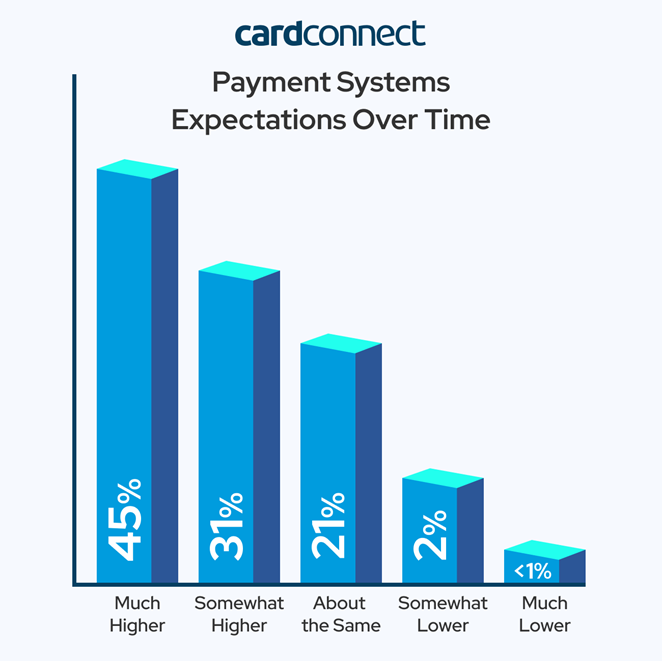
Small businesses are recalibrating what “good” looks like in payments.
- 76.5% say their expectations for payment systems are higher than they were three years ago.
- Nearly half report expectations are “much higher.”
This is not a reaction to a single disruption. It reflects a broader shift in operating environments. Businesses are managing more digital touchpoints, more customer payment preferences, and more interconnected systems than in the past.
Notably, the operating mix of respondents reinforces this reality. More than eight in ten surveyed businesses operate either online-only or across both online and physical channels. The modern small business is digital by default.
Expectations are rising because the role of payments has expanded.
Reliability Is the Foundation
Across multiple measures, one theme emerged consistently: reliability.
Reliability ranked as:
- The #1 essential payment capability
- The #1 factor when evaluating providers
- The #1 switching trigger
When asked which capabilities are essential today, nearly half of respondents selected fast, reliable transaction processing. When asked what matters most in evaluating payment solutions, reliability again ranked first. And when asked what would cause them to consider switching providers, downtime and reliability issues led the list.
The message is straightforward. Reliability is not a differentiator. It is a prerequisite.
What Drives Switching
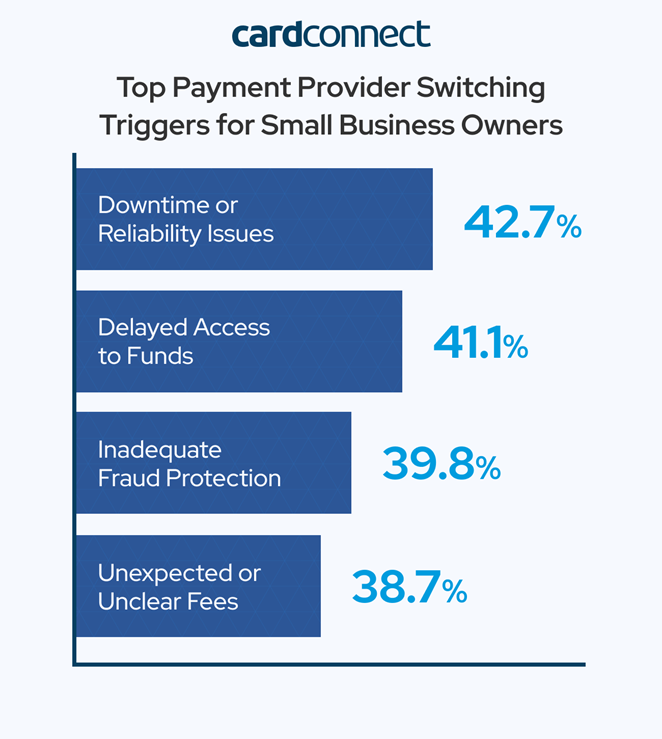
While expectations are rising, businesses are not broadly dissatisfied. Nearly 79% report confidence that their current payment setup meets their needs today.
However, certain conditions would quickly change that equation.
When asked what would prompt them to consider switching providers, respondents identified:
- Downtime or reliability issues — 42.7%
- Delayed access to funds — 41.1%
- Inadequate fraud protection — 39.8%
- Unexpected or unclear fees — 38.7%
These drivers reflect operational risk more than feature comparison.
Reliability remains central, but funding speed, fraud protection, and pricing clarity are close behind. Switching decisions appear rooted in business continuity and economic trust.
Speed and Visibility Are Becoming Standard Expectations
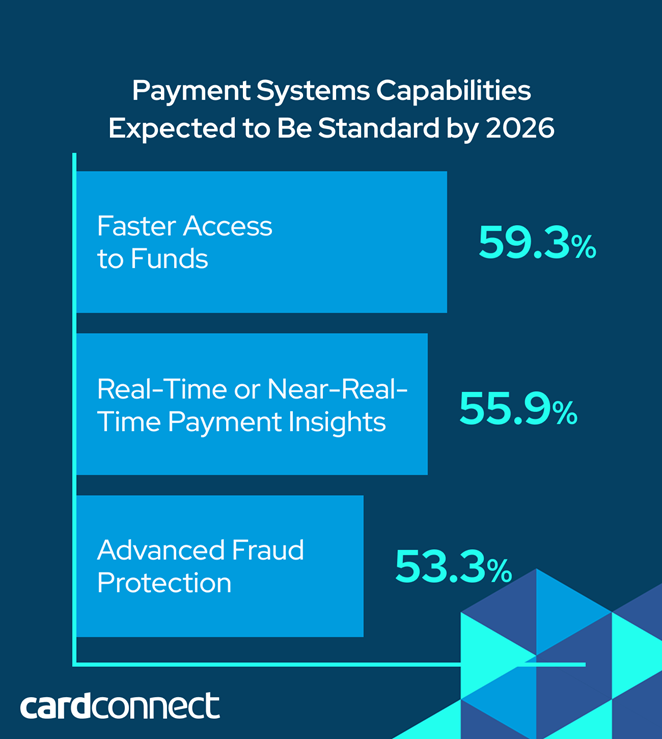
In addition to stability, small businesses increasingly expect immediacy.
When asked which capabilities should become standard by 2026, respondents pointed to:
- Faster access to funds — 59.3%
- Real-time or near-real-time payment insights — 55.9%
- Advanced fraud protection — 53.3%
Interestingly, predictable funding timelines ranked lower as an “essential” capability today. Yet delayed access to funds is one of the top switching triggers, and faster funding is widely expected to become standard in the near future.
This suggests funding speed may not dominate decision-making until it fails or becomes constrained. As businesses anticipate greater complexity, immediacy is becoming part of the baseline.
The direction is clear. Visibility and speed are moving from advantage to expectation.
Complexity Is Increasing
Small businesses recognize that their payment environments are evolving.
- 60.1% expect their payment needs to become more complex over the next two years.
That complexity is driven by multiple factors:
- Expansion across online and in-person channels
- Integration with accounting and back-office systems
- Fraud and risk management requirements
- Managing multiple payment types and data streams
At the same time, 78.8% feel confident in their current setup.
This tension is telling. Businesses feel stable today, but anticipate that future demands will require more coordination and integration.
Ease of integration may not rank as the top immediate priority. Yet nearly one-third expect easier integrations to become standard, and more than a quarter say lack of integration could cause them to switch providers. Integration may not drive initial selection, but it increasingly shapes long-term sustainability.
Transparency and Margin Pressure
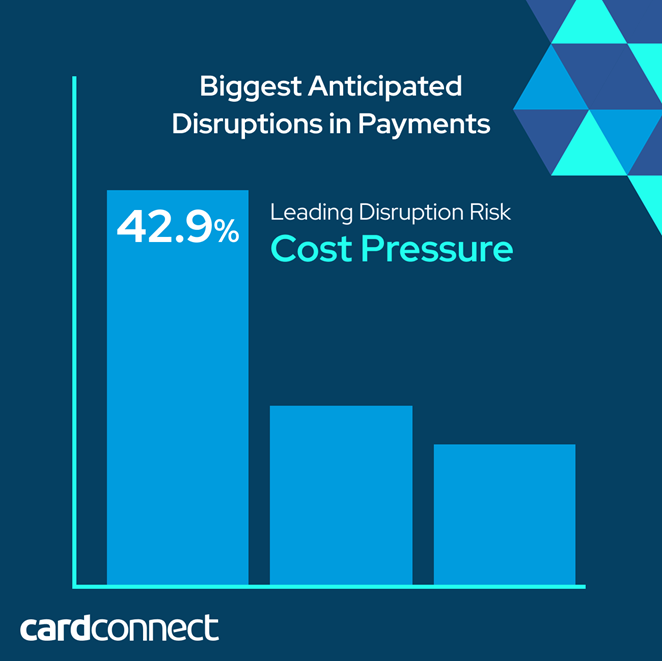
When asked about the biggest potential disruption over the next 12–24 months, respondents most frequently cited rising processing costs and margin pressure.
- 42.9% identified cost pressure as the leading concern.
- Fraud and chargeback risk followed at 20.9%.
- Integration challenges ranked third.
Clear and transparent pricing also ranked among the most essential capabilities today. And nearly 39% said unexpected or unclear fees would cause them to consider switching providers.
As margins tighten, economic clarity becomes a strategic factor. Expectations around transparency are not separate from expectations around reliability. They are part of the same trust equation.
What This Signals for the Payments Landscape
Taken together, the findings point to several structural shifts:
- Reliability is assumed, not appreciated.
- Funding speed and real-time insight are becoming baseline expectations.
- Fraud protection is viewed as operational resilience.
- Integration is increasingly necessary as ecosystems expand.
- Pricing clarity is critical in a margin-sensitive environment.
Small businesses are not asking for dramatic innovation. They are asking for consistency, transparency, and alignment with how they operate today.
Expectations have risen. Complexity is increasing. Cost pressure remains top of mind.
The providers best positioned for the years ahead will be those that simplify complexity while delivering stability, speed, and clarity in an increasingly interconnected payments environment.
About the Research
This survey was conducted among 382 U.S.-based small business owners and managers ages 24–80 who are actively involved in payments decision-making and currently accept electronic payments.
Respondents represented online-only, brick-and-mortar-only, and omnichannel businesses across a range of industries and revenue levels. Screening questions ensured participants had direct or shared responsibility for evaluating or selecting payment providers.
The survey was fielded in February 2026 through a third-party research panel. Results reflect self-reported responses and are unweighted.
INTERNAL USE ONLY: Media Angles the PR Team Can Use
From a PR perspective, there are several strong storylines that can come out of this research.
1. Rising Expectations
The headline stat is that 76.5% of small businesses say their expectations for payment systems are higher than three years ago.
That is a clean, compelling narrative about how the payments environment is evolving.
2. Reliability Is Now Table Stakes
Reliability showing up as the top capability, evaluation factor, and switching trigger is a strong story for payments and fintech trade media.
It reinforces the idea that stability is foundational infrastructure.
3. Payments Are Becoming More Complex
The finding that 60% of businesses expect payment complexity to increase opens the door to conversations about integration, omnichannel coordination, and ecosystem management.
That angle works well for fintech and technology outlets.
4. Cost Pressure and Transparency
Finally, the fact that 42.9% cite rising processing costs as the biggest disruption ahead broadens the story beyond payments technology and into broader small business economics.
5. Speed and Real-Time Insight Are Becoming Standard
The expectation that faster funding and real-time insights should become baseline capabilities by 2026 speaks directly to where the market is heading.
Note to CardConnect: Can you make these numbers stand out in some way? Either larger font size, different color, etc?